


Choosing the Perfect Outdoor Table: A Checklist for Philadelphia & Jersey Shore Homeowners
Most homeowners spend more replacing "temporary" luxury furniture every three seasons than they would have spent on a single, permanent investment. It's a frustrating cycle that compromises the aesthetic of your home and interrupts your leisure time. You've likely seen it happen: a beautiful outdoor table that looks stunning in May but begins to fade, pit, or rust by the time the first September breeze hits the Jersey Shore.
We understand that your backyard is more than just a patio; it's a personal sanctuary for connection and relaxation. You deserve the peace of mind that comes with weather-resistant materials like powder-coated aluminum or Grade A teak that can withstand 41 inches of annual rainfall and high-humidity Philadelphia summers. This checklist provides the expert framework you need to choose a piece that matches your home’s architecture while meeting modern BIFMA OF-2025 durability standards. We'll cover everything from precision spatial planning to the specific materials that thrive in our unique Mid-Atlantic environment.
Key Takeaways
Learn how to select materials based on your specific microclimate, prioritizing wind-resistant frames for the Jersey Shore and heat-reflective surfaces for unshaded Philadelphia patios.
Master spatial planning by applying the 36-inch rule, ensuring your new outdoor table provides ample clearance for seamless guest movement and chair transitions.
Identify the most resilient materials for coastal living, focusing on non-ferrous metals and high-density polyethylene to prevent salt-air corrosion and pitting.
Define your ideal entertaining style by matching specific table heights to your home's architectural flow and intended social use.
Establish a year-round protection strategy by determining if your chosen collection requires specialized covers or is engineered for permanent exposure to the elements.
Table of Contents The Material Selection Checklist: Choosing Your Outdoor Table Foundation Size and Configuration: A Spatial Planning Checklist The Durability Checklist: Surviving the Philadelphia and Jersey Shore Climate
The Material Selection Checklist: Choosing Your Outdoor Table Foundation
Selecting the foundation for your outdoor table requires a nuanced understanding of your local microclimate. Homeowners in Stone Harbor or Avalon face 40 to 51 inches of annual precipitation and relentless salt spray, which demands heavy, non-corrosive materials. In contrast, a sheltered patio in Ardmore might prioritize heat management over wind resistance. Before finalizing your choice, evaluate these critical performance factors:
Weight and Stability: High-wind coastal areas require heavy frames to prevent furniture from becoming airborne during storms.
Heat Retention: Darker metals can reach uncomfortable temperatures in the 87.1°F Philadelphia July heat; lighter finishes or wood tops are better for unshaded spots.
Finishing Quality: Verify that metal components feature a multi-stage powder-coating to prevent oxidation and rust.
Material Density: High-density polyethylene (HDPE) should be consistent throughout the piece to avoid structural "fringe" cracking.
When evaluating common materials for outdoor furniture, the goal is to balance aesthetic appeal with the technical requirements of the Mid-Atlantic climate.
Aluminum and Teak: The Longevity Leaders
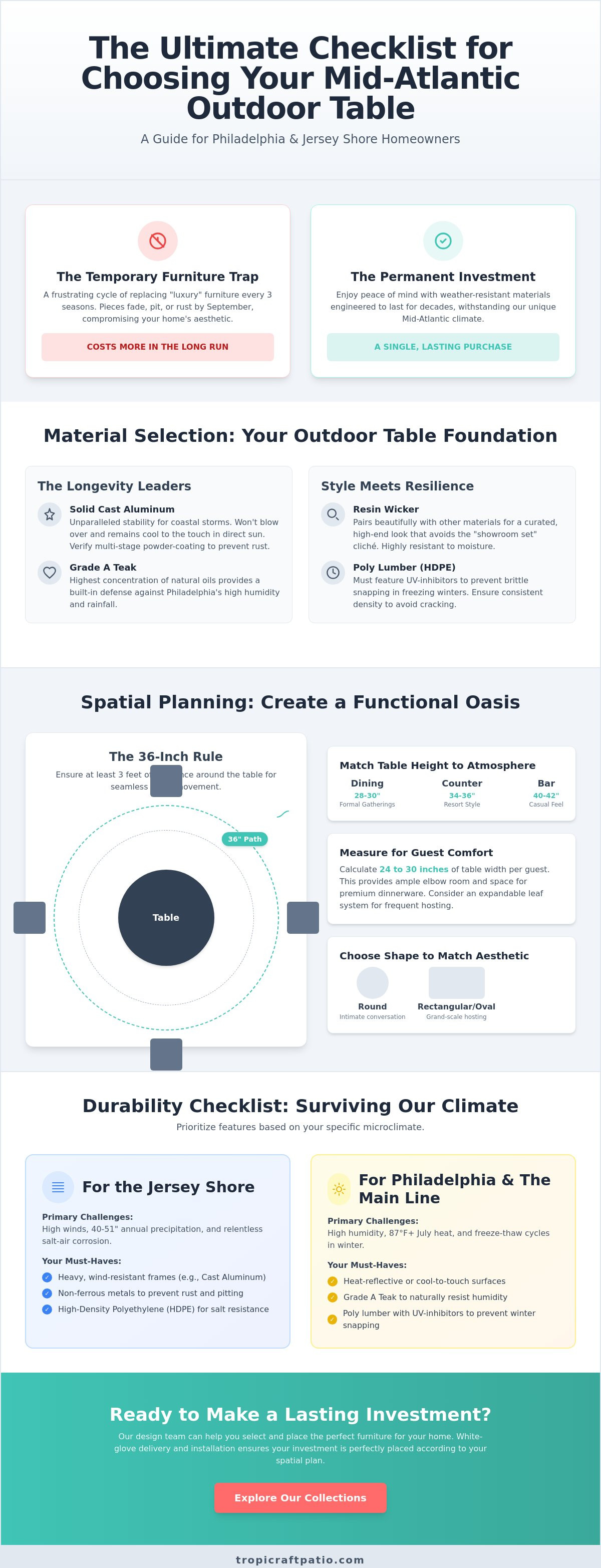
Solid cast aluminum offers unparalleled stability compared to hollow, tubular frames. It won't blow over during a coastal storm, yet it remains cool to the touch even in direct sun. For those who prefer the warmth of wood, Grade A teak is essential. It contains the highest concentration of natural oils, which acts as a built-in defense against the humidity that characterizes our region.
Resin Wicker and Poly Lumber: Style Meets Resilience
Sophisticated design often involves mixing textures. You can pair a sleek aluminum outdoor table with resin wicker chairs for a curated, high-end look that avoids the "showroom set" cliché. Ensure your poly lumber choices feature UV-inhibitors to prevent brittle snapping during freezing winters. This material synergy ensures your oasis remains both beautiful and functional for decades.
Size and Configuration: A Spatial Planning Checklist
Precision spatial planning transforms a simple patio into a functional extension of your home. Selecting an outdoor table involves more than just matching a style; it requires understanding the social flow of your unique environment. While some retailers suggest standard sizing, a truly sophisticated layout prioritizes the "36-Inch Rule." This ensures at least three feet of clearance around the table, allowing guests to move comfortably without disturbing others. This attention to detail is what separates a cramped deck from a private retreat.
Match your table height to the intended atmosphere. Standard dining (28-30") is ideal for formal gatherings, while counter (34-36") or bar heights (40-42") evoke a casual, resort-style feel. For the uneven slate or stone patios common in Villanova and King of Prussia, adjustable leveling feet are a non-negotiable feature for stability. If you prefer an unobstructed view, skip the center umbrella hole and opt for a cantilever shade solution. Investing in durable patio furniture is only the first step; the layout determines the ultimate function.
Measuring for Comfort and Social Flow
To avoid crowded dining, calculate 24 to 30 inches of table width per guest. This provides ample elbow room and space for premium dinnerware. If you frequently host high-occupancy holiday gatherings on the Main Line, consider an expandable leaf system. These mechanisms allow you to transition from intimate family meals to grand celebrations without compromising your daily spatial flow.
Matching Table Shape to Your Backyard Aesthetic
Shape influences the energy of your oasis. Round tables are perfect for intimate conversation in smaller, circular Ardmore garden nooks. Rectangular and oval tables better suit grand estates, providing the scale necessary to anchor a large-scale hosting area. A common frustration with luxury furniture is the assembly process; we bridge this gap by offering white-glove delivery and installation, ensuring your investment is perfectly placed according to your spatial plan. Consult with our design team to visualize your ideal layout.
The Durability Checklist: Surviving the Philadelphia and Jersey Shore Climate
Philadelphia homeowners face 41.53 inches of annual rainfall, while those at the Jersey Shore must contend with corrosive salt spray and high humidity. A high-end outdoor table must be engineered to withstand these specific Mid-Atlantic stressors without losing its structural integrity. Generic furniture often relies on low-grade steel that rusts within a single season in Ventnor or Avalon. To ensure your investment survives, prioritize these technical specifications:
Salt Air Resilience: Choose non-ferrous metals like aluminum or high-density polyethylene (HDPE) for coastal properties to prevent pitting and corrosion.
Hardware Integrity: Verify that all connectors and screws are marine-grade stainless steel. This prevents "rust weeping" that can permanently stain expensive patio stone.
Cushion Synergy: If your dining set includes seating, ensure the use of Sunbrella fabrics to maintain color depth against the intense 87.1°F July sun.
Winter Strategy: Determine if your piece is rated for year-round exposure or if it requires protective covers during the 22.4 inches of average annual snowfall.
Winterization and Long-Term Care
Maintaining a sophisticated retreat requires minimal but consistent effort. A simple rinse with mild soap and water twice a season prevents the buildup of environmental pollutants and salt residue. Periodically inspect the finish of your furniture. Minor touch-ups on powder-coated surfaces prevent oxidation from taking hold, preserving the original craftsmanship for decades.
The ROI of Quality: Why Luxury Lasts
A premium outdoor table is an investment in your long-term lifestyle. When you analyze the cost-per-year, a table that lasts 15 years far outperforms three commodity sets that require replacement every three seasons. Selecting a piece from a premier outdoor furniture store ensures you have access to local expertise and legitimate warranties. This long-term value provides the peace of mind necessary to truly enjoy your personal oasis.
Designing Your Permanent Outdoor Sanctuary
A luxury outdoor table is far more than a simple piece of furniture; it's the anchor of your personal retreat. By prioritizing material resilience against the Mid-Atlantic’s humidity and salt air, you transform your patio into a lasting investment in your lifestyle. Remember to maintain the 36-inch clearance rule we discussed to ensure your social flow remains as sophisticated as your design.
Since 1977, our family-owned business has helped homeowners navigate the transition from indoor comfort to outdoor luxury. We invite you to experience our collections firsthand within our 20,000 sq. ft. historic showroom in Ardmore. Our team provides professional white-glove delivery across Pennsylvania and New Jersey, ensuring your vision is realized with precision and care.
Explore our curated outdoor table collections at our Ardmore showroom and begin creating the oasis you've always imagined.
Frequently Asked Questions
What is the best material for an outdoor table at the Jersey Shore?
Non-ferrous materials like powder-coated cast aluminum and high-density polyethylene (HDPE) are the superior choices for coastal environments. These materials are naturally impervious to the corrosive salt spray that quickly degrades standard steel or low-grade wrought iron. Because sea levels at the Jersey Shore rose over 8 inches between 1979 and 2019, choosing materials that resist moisture and flooding is a critical long-term investment for your property.
How much space do I need around my patio dining table for chairs?
You should maintain a minimum of 36 inches of clearance on all sides of your outdoor table to allow for comfortable guest passage. If your space allows, 48 inches of perimeter space creates a more sophisticated, resort-like feel. This ensures that chairs can be pulled out fully without hitting walls or railings, preserving the tranquil atmosphere of your private sanctuary during social gatherings.
Can I leave my aluminum or poly lumber table outside during a Philadelphia winter?
High-quality aluminum and poly lumber collections are engineered to withstand the 22.4 inches of snow typical of a Philadelphia winter. These materials meet BIFMA OF-2025 standards for temperature and moisture extremes, meaning they won't crack or warp in freezing conditions. While your outdoor table can remain outside, using custom-fit covers will reduce the maintenance required when the entertaining season begins in April.
How do I choose between a round or rectangular outdoor table for my space?
Select a round table to foster intimate conversation in smaller garden nooks or circular architectural spaces. Rectangular tables are better suited for grand estates and large-scale hosting, providing the structure needed to seat 8 or more guests comfortably. If your hosting needs vary, an expandable rectangular table with a self-storing leaf offers the most flexibility for both quiet family dinners and larger celebrations.


Comments