


Is Teak Furniture Worth the Investment in PA? A Guide to Longevity and ROI
Updated: Jul 15
What if your outdoor sanctuary didn't require an annual restoration ritual just to survive the next Susquehanna humidity spike or a brutal Pocono freeze? You’ve likely felt the frustration of watching a once-beautiful set warp, crack, or lose its luster after just a few seasons in our unpredictable climate. When considering your patio's future, the central question remains: is teak furniture worth the investment in PA? For those who prioritize a lifestyle of relaxation over a schedule of constant repairs, the answer lies in the wood's unique biological resilience.
Discover why premium teak is the definitive long-term choice for Pennsylvania’s specific weather patterns, from humid valleys to heavy mountain snow. We’ll examine how this material compares to other luxury outdoor options and detail the impact of new 2024 Lacey Act declarations on sustainable sourcing. This guide provides the clarity you need to transform your deck into a high-value heritage asset that grows more beautiful with every passing year.
Table of Contents
The Biological Edge: Why Teak Thrives in Pennsylvania’s Volatile Climate
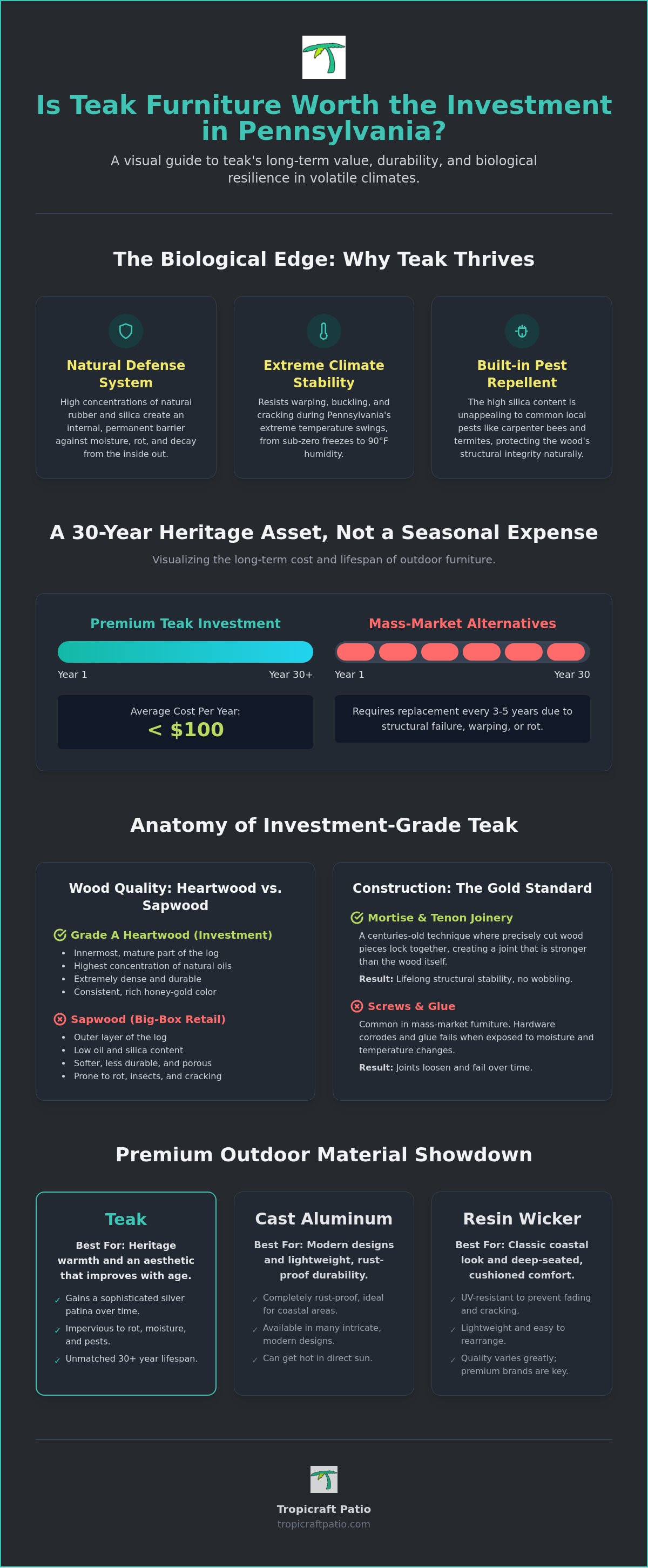
To understand why Teak (Tectona grandis) remains the gold standard for outdoor living, we must look at its cellular composition. Unlike domestic hardwoods, genuine teak contains an exceptionally high concentration of natural rubber and silica. These elements act as an internal weatherproofing system, creating a permanent barrier against moisture and rot from the inside out. This unique biological profile ensures the wood remains incredibly stable. While other materials expand and contract violently during a 90-degree July afternoon or a sub-zero January night, teak stays still. It doesn't warp, buckle, or lose its shape. This structural integrity is a primary reason why many homeowners conclude that is teak furniture worth the investment in PA, as it eliminates the frustration of wobbly frames and misaligned joints.
Beyond weather resistance, these same natural oils offer a built-in defense against local pests. Carpenter bees and termites, which often plague wooden decks in the Mid-Atlantic, find the high silica content of teak unappealing. There is also a distinct tactile luxury to the material. It retains a gentle, organic warmth that never feels searing in the midday sun or bone-chilling in the autumn. This provides a sensory comfort that metal frames simply cannot replicate, making your patio feel like a true extension of your home's interior sanctuary; for those seeking to mirror this quality indoors, Grosvenor Furniture offers a similar commitment to high-end craftsmanship.
Surviving the Mid-Atlantic Freeze-Thaw Cycle
Pennsylvania’s winter presents a specific challenge: the constant cycle of melting snow refreezing in the grain. Lower-density woods like cedar or pine absorb water that expands as it turns to ice, causing the wood to split and crack. Teak’s dense, tight grain prevents this water absorption entirely. Your furniture remains intact and structurally sound, even after a decade of harsh winters on the Main Line.
The Salt-Air Factor: Teak for Jersey Shore Properties
For those with coastal retreats in Ventnor or Avalon, salt spray is a relentless adversary. It corrodes most metals and degrades low-quality wicker, but teak thrives in these conditions. Over time, the wood develops a sophisticated silver patina. This oxidized layer serves as a natural shield, requiring zero chemical treatments to protect your investment from the corrosive coastal air.
Calculating the ROI: Teak’s Long-Term Value vs. Seasonal Replacements
For many Main Line homeowners, the decision to refine an outdoor space is often viewed through the lens of legacy. When asking if is teak furniture worth the investment in PA, it's helpful to shift the perspective from a five-year expense to a thirty-year heritage asset. Just as collectors of fine horology might visit luxurytimenyc.com to find investment-grade timepieces that retain their value, choosing premium teak ensures your outdoor furniture remains a high-value asset for decades. While the initial acquisition reflects its premium status, the "Cost Per Year" metric tells a more compelling story. Over a three-decade lifespan, a high-quality teak set often costs less than $100 per year, far outperforming mass-market alternatives that inevitably require replacement every few seasons due to structural failure.
This longevity isn't merely anecdotal; the USDA Forest Products Laboratory has rated as very durable the heartwood of the teak tree. This inherent strength translates directly into resale value within the luxury real estate market. A well-curated teak collection is frequently viewed as a permanent fixture that enhances a property's overall appeal. To complete the aesthetic, many clients pair their frames with custom outdoor cushions in Ardmore, creating a fully tailored sanctuary that mirrors the comfort of their home's interior.
Maintenance Reality: Patina vs. Preservation
Teak offers a unique choice: embrace the natural aging process or preserve the original honey hue. Unlike other hardwoods that demand annual sanding and staining to prevent rot, teak can be left entirely alone. It'll gracefully transition to a sophisticated silver-gray patina without losing an ounce of structural integrity. A simple annual cleaning with mild soap is all that's required to maintain your retreat for decades.
Teak vs. Aluminum and Wicker: Which Investment Fits Your Lifestyle?
Teak: Choose this for heritage warmth and an aesthetic that actually improves as it matures.
Cast Aluminum: Ideal for modern designs and those who prefer lightweight, rust-proof durability.
Resin Wicker: Perfect for a classic coastal look and deep-seated, cushioned comfort.
Premium teak stands alone as the only material that gains character with age. If you're ready to begin curating your own private retreat, we invite you to connect with our design consultants for a personalized consultation.
Curating Your Sanctuary: How to Select Investment-Grade Teak
Selecting the right pieces for your retreat requires a discerning eye for material grade and construction methods. When homeowners ask is teak furniture worth the investment in PA, the answer often comes down to the distinction between Grade A heartwood and inferior sapwood. Grade A teak is harvested from the center of mature trees, typically over 30 years old, where the concentration of natural oils is highest. In contrast, the lighter sapwood often found in mass-market retail lacks the biological defense to survive Pennsylvania's seasons. For a deeper look at technical specifications, reviewing an investment-grade teak selection confirms why heartwood remains the gold standard for durability.
Structural integrity depends on more than just the wood species; it relies on time-honored craftsmanship. Look for mortise and tenon joinery, a technique where a protruding tenon fits precisely into a carved mortise hole. This creates a bond far superior to simple screws or glue, which often fail under the stress of temperature-induced expansion. We invite you to experience these details firsthand at our Philadelphia-area furniture store. Seeing the grain density and feeling the natural oil content in person provides a level of certainty that digital browsing cannot replicate.
Identifying Grade A Quality in the Showroom
Visual Consistency: Genuine Grade A teak displays a rich, uniform honey-gold color with tight, straight grain lines. Avoid pieces with dark knots or white streaks, as these indicate the presence of weaker sapwood.
The Weight Test: Because of its high density and oil content, premium teak is significantly heavier than Grade B or C alternatives. A solid dining chair or chaise should feel substantial and immovable.
The Heritage Advantage: Furniture That Outlasts the Mortgage
High-end teak is more than a purchase; it's a legacy item designed to be passed down through generations. Much like an heirloom indoor table, these outdoor sets become a permanent part of your family’s history. Our professional delivery and installation services ensure your heavy teak collections are placed perfectly within your garden sanctuary, allowing you to begin your journey toward lasting outdoor luxury immediately. Please contact us for a personalized design consultation in Ardmore to find the perfect fit for your home.
Elevating Your Outdoor Sanctuary for Generations
Defining the character of your patio is a journey that should only be taken once. By understanding the biological resilience of heartwood and the structural integrity of traditional joinery, you ensure your space remains a tranquil retreat regardless of the Mid-Atlantic’s volatile shifts. When you weigh the decades of maintenance-free leisure against the cycle of seasonal replacements, the answer to whether is teak furniture worth the investment in PA is found in the enduring beauty of the material itself.
Since 1977, we've served as a trusted partner for Philadelphia homeowners seeking to transform their backyards into high-end sanctuaries. We invite you to visit our 20,000-square-foot showroom in historic Ardmore to experience the prestige of our collections in person. From initial selection to our expert white-glove delivery and installation, we're here to guide you toward a legacy of comfort. Explore our curated Teak Collections at Tropicraft Patio and begin your investment in a lifetime of outdoor elegance.
Frequently Asked Questions
Does teak furniture need to be covered during a Pennsylvania winter?
Teak furniture does not strictly require covering during a Pennsylvania winter because its high oil content prevents moisture from causing structural damage. While the wood survives the freeze-thaw cycle unscathed, many owners choose to use breathable protective covers to minimize spring cleaning. This prevents leaves, dirt, and soot from settling into the grain, ensuring your sanctuary is ready for use as soon as the first warm day arrives in April.
How do I prevent my teak furniture from turning gray if I prefer the gold look?
You can maintain the original honey-gold hue by applying a high-quality teak sealer once a year after a thorough cleaning. Unlike teak oil, which can encourage mildew growth in our humid summers, a sealer contains UV inhibitors that lock in the natural color. This simple maintenance step allows you to preserve the vibrant showroom look while still benefiting from the wood's legendary durability and internal weatherproofing.
Is teak furniture better than poly lumber for a Philadelphia home?
Choosing between these materials depends on whether you prioritize organic luxury or zero-maintenance practicality. Teak offers an unmatched sensory experience and a sophisticated aesthetic that increases in value over time. Poly lumber is excellent for high-traffic areas or poolside use where chemical resistance is key. For a primary terrace, many homeowners find that is teak furniture worth the investment in PA because it provides a level of prestige that synthetic materials cannot match.
Why is Grade A teak so much more expensive than the teak at big-box retailers?
Grade A teak is harvested exclusively from the center of mature trees, which takes thirty to fifty years to develop the necessary oil and silica levels. Big-box retailers often sell Grade C teak, which is immature sapwood that lacks these natural defenses and will likely rot within a few seasons. Investing in Grade A ensures you're purchasing a lifetime asset rather than a temporary solution that requires frequent replacement.


Comments